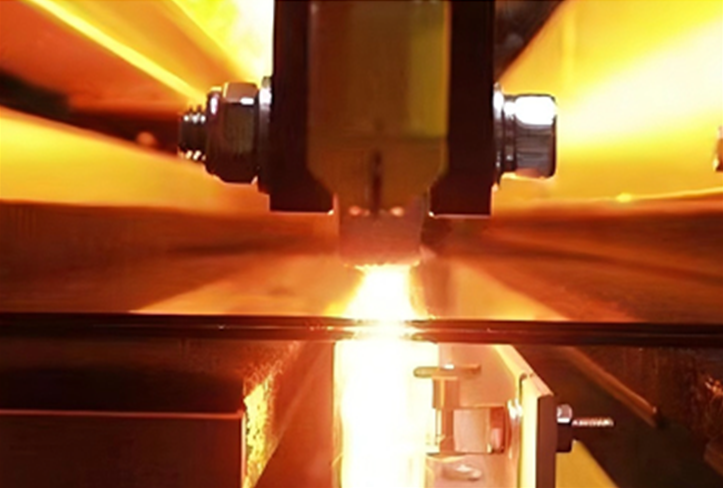
On the glass transfer line, sublimation ink is finicky—you have to stay inside a tight thermal window. Heat it too slow, and the image feathers. Heat it uneven, and you get mottling plus stress marks that will still be there after downstream handling. The heater has to slam the substrate up to temperature fast, hold the setpoint without drifting, and do it again, cycle after cycle. What matters, technically We build our sublimation-on-glass heaters around short-wave NIR quartz emitters. The point is fast response and low thermal inertia. The emitters throw high radiant density straight onto the glass surface, bypassing air and skipping the lag you get with convection-heavy ovens. We match the spectral output to the ink’s absorption profile, so the energy lands where it’s needed and you don’t waste it. The module is rated for 240 V or 480 V, sized to fit standard frames, and wired with industrial connectors so replacements are repeatable. Temperature uniformity comes from a zoned layout and a calibrated control strategy that keeps a hot edge from overdriving while the center catches up. Why this works in production Out on the line, the scoreboard is yield and uptime. Rapid heat-up shortens the dwell window, so you can push line speed without giving up transfer quality. Uniform heat distribution prevents localized overheating that can drive thermal stress in tempered or coated glass—fewer breaks, less rework. Energy use drops because NIR hits the substrate directly instead of heating the whole chamber. And the module is engineered as a drop-in replacement, so you can swap it in without re-engineering the conveyor or rewriting the recipe. Things to keep straight NIR emitters are line-of-sight, so workpiece geometry and spacing have to be consistent. Keep the surface clean—dust and residues change emissivity and can create hot spots. Verify the power supply and cooling path. These heaters run hot at the emitter, and airflow matters. If you’re running low-iron glass, confirm the spectral match with your ink supplier. Absorption shifts a bit, and the control tuning should follow. Plan for routine calibration checks, and the unit will hold setpoint reliably, shift after shift.